Resin Roof Tile SpecificationsWhat sizes are available?
I’ve been working in building materials procurement for several years now, and during that time I’ve handled a wide variety of roofing materials. Resin tiles have become particularly popular in recent years, and many people come to me asking about them—the most common question I get is about their specifications and dimensions. Today, I’ll explain this topic in detail.
Currently, the most common width for resin roofing tiles on the market is 1,051 millimeters. This standard was not established arbitrarily; rather, it is closely tied to the width of the manufacturing equipment’s production lines and is also related to specific transportation conditions and numerous other factors. A width of approximately 1,051 millimeters not only effectively ensures that roofing coverage efficiency meets the required standards and satisfies demand but also avoids causing significant difficulties or complications during the overall transportation process. Some manufacturers also produce models with widths of 1,101 millimeters or 1,251 millimeters; however, the effective coverage width in actual use will gradually decrease to varying degrees due to factors such as the overlapping of tiles. Therefore, when making a purchase, you should never base your decision solely on the product’s nominal width.
In terms of thickness, the three most common options currently available on the market are 2.0 mm, 2.5 mm, and 3.0 mm. The difference between these thicknesses is not merely a matter of material usage; it also marks a critical distinction in terms of service life and wind resistance. In southern regions prone to typhoons, I usually recommend that customers choose a thickness of at least 2.5 millimeters, with 3.0 millimeters being the safer option. In northern regions, although winds are not as strong, significant temperature fluctuations and snow and ice loads should not be overlooked; if the thickness is too thin, problems are highly likely to arise later on.
In terms of length, resin roofing tiles can be custom-made; theoretically, there is no fixed upper limit. However, considering the practicality of hoisting and installation, it is generally more reasonable to manufacture them to be 6 meters or less in length. Once this length is exceeded, installation difficulty increases significantly, and transportation costs rise accordingly. Many contractors, seeking to simplify the process, limit the length to between 3 and 5 meters; this allows a standard truck to transport over a dozen sheets at a time, resulting in higher efficiency.
How to Choose the Right Thickness and Width
When selecting the specifications for resin roofing tiles, you shouldn’t just look at the price; instead, you need to make a decision based on a comprehensive evaluation of several factors. I’ve seen countless people who, lured by low prices, ended up buying thin, low-quality tiles. As a result, the tiles began to age and crack within two or three years, and the cost of the subsequent repairs ended up being more than the money they had initially saved.
The intended use of the building is quite critical. If it’s a private villa or a self-built home with a roof pitch of 25 degrees or more, a thickness of 2.5 millimeters is generally sufficient. However, if the roof is for a factory building or a sunshade—where spans are large and wind load requirements are high—it is recommended to use 3.0 millimeters or even thicker. Additionally, in the case of renovating older homes where the original tiles are already rusted or damaged, when installing new resin tiles, if the substrate is not sufficiently level, thinner tiles are more prone to sagging and warping.
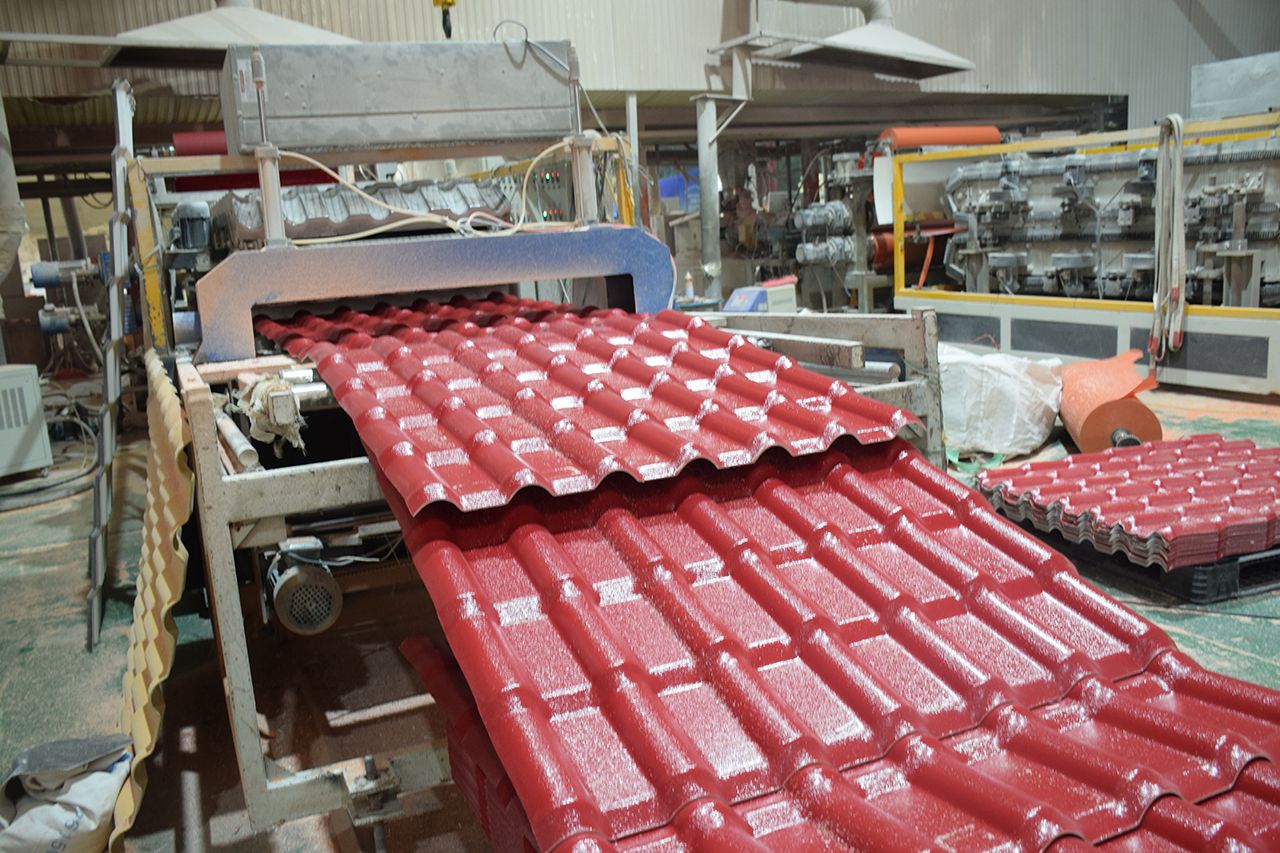
This data is based on the material formulation and extrusion process, so it’s not just empty talk. The warranty period for resin roofing tiles is directly linked to their thickness; 2.0-millimeter tiles generally come with a 15-year warranty, while 2.5-millimeter tiles can reach 20 years. and some manufacturers even offer a 30-year warranty on 3.0-millimeter resin roofing tiles. High-quality resin roofing tiles utilize ASA co-extrusion technology for the surface layer, which provides significantly better weather resistance and UV resistance compared to ordinary PVC roofing tiles. This is the key reason why resin roofing tiles are recommended over ordinary PVC roofing tiles.
When it comes to choosing the width, in addition to the standard 1,050-millimeter style mentioned earlier, narrow-width products are sometimes used in specific situations—such as roofs with complex shapes and numerous corners. Narrow tiles fit these areas more easily and result in less material waste. Furthermore, when renovating older homes, if the spacing of the original roof trusses is relatively tight, narrow tiles are easier to install. However, since narrow tiles have a lower coverage rate, labor costs will increase accordingly—this is a factor that needs to be carefully calculated.
Resin Roof Tile Specifications and Installation Precautions
Even if the right specifications are chosen, the installation process must not be taken lightly. The installation method for resin roofing tiles differs from that of traditional tiles; it uses a overlapping batten installation technique, which places relatively high demands on the substrate.
The spacing between roof battens should be determined by the thickness of the resin roof tiles. For tiles that are 2.5 millimeters thick, the spacing between roof battens is typically kept at around 400 millimeters; for tiles that are 3.0 millimeters thick, the spacing between the battens can be appropriately increased to 500 millimeters. If the spacing is too close, it will result in material waste; if it is too sparse, the stress on the tiles will be uneven, making them prone to loosening during strong winds. I once encountered a situation where a construction crew, to save time, increased the spacing to 600 millimeters. As a result, after a typhoon passed, several tiles were blown off, and the cost of rework was considerable.
Regarding the handling of overlapping edges, this is also a matter of detail. For horizontal overlaps, the overlap must extend beyond one wave crest; for vertical overlaps, the overlap must be at least 150 millimeters. Nails should be driven into the interior of the overlap area and must not be driven into the exposed wave surface. Many workers, for the sake of convenience, drive nails too close to the edge. Over time, due to thermal expansion and contraction, leaks develop at the seams. The waterproofing performance of the resin roofing tiles themselves is not an issue; the problem lies in the installation process.
Another point that is often overlooked is expansion joints. While resin roofing tiles have a lower coefficient of thermal expansion than metal roofing tiles, they are not entirely immune to thermal expansion and contraction. In summer, temperatures can reach over 60 degrees after prolonged exposure to the sun, while in winter they may drop below freezing. Therefore, for roofs with sections longer than 15 meters, it is recommended to include an expansion joint to prevent the tiles from warping or buckling.
There is no single, definitive answer when it comes to choosing the specifications for resin roofing tiles; rather, the decision should be based on actual needs. A width of 1,050 millimeters combined with a thickness ranging from 2.5 to 3.0 millimeters is currently the most widely used combination, offering a relatively balanced blend of cost-effectiveness and durability. When making a purchase, be sure to choose a reputable manufacturer, request test reports, and obtain a warranty certificate—never let yourself be deceived by low prices. The roof is the face of a house; if the materials are selected correctly, you won’t have to worry about it for eight to ten years.
Keywords: Resin Roof Tile Specifications