Resin tiles have become a widely used roofing material in current sloped roofing projects due to its strong weather resistance, light weight, convenient construction and other characteristics.. However, to ensure the long-term stability and reliability of resin tile roofing, pre-installation preparation should not be overlooked. Good construction begins with adequate preparation, which is the key to ensuring the quality of the installation and extending the service life of the shingles.
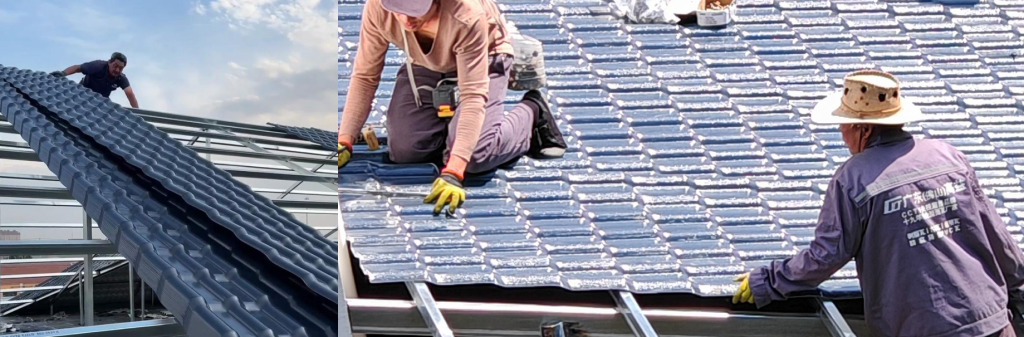
Preparation work before resin tile installation
I. Roofing grass-roots requirements and purlin treatment
The base layer of resin tile can be steel structure, wood structure or concrete roof. Steel purlin should be used for the steel structure, it is recommended to use square pipe (60mmx40mmx3mm) or C-type steel (100mmx20mmx3mm) or anticorrosion wood square (60x40mm), arranged from bottom to top, need to remove the rust in advance and brush with anticorrosion paint, to avoid rust and corrosion in the later stage affecting the load-bearing.. Steel purlins need to be brushed with anti-rust oil and two top coats to prolong service life. Wooden structure grassroots should choose dry solid wood purlin, moisture content should be controlled within 15%, to avoid deformation or cracking due to wet expansion and dry contraction in the later stage; wood purlin need to be treated with anticorrosive oil or asphalt oil immersion brushes. The concrete base, on the other hand, needs to be leveled ahead of time, cracks and depressions repaired, and the surface ensured to be free of sharp debris to prevent poking through the shingles.
The control of purlin spacing is the key in the base treatment. The purlin spacing varies according to the thickness of the resin tile:
2.0mm<thickness≤2.5mm, purlin pitch 660mm
2.5mm<thickness≤3.0mm, purlin pitch 880mm
Note: ① If the ventilation conditions of the room is poor, the higher the temperature, the smaller the spacing design of the sandalwood should be, otherwise it is easy to trigger the deformation of the tile.
The top purlin is about 150mm from the ridge line and the bottom purlin is about 50-70mm from the eave opening. Before installation, purlins should be checked for flatness one by one, and the height difference between installed purlins should be controlled within ±5mm, and be welded or bolted according to design requirements.。
II. Roof slope requirements
Resin tiles are suitable for sloped roofs from 20° to 80°, where smooth drainage can be ensured to avoid waterlogging problems.. If the roof slope is small (e.g. close to 18.5°), it is more important to pay attention to the waterproofing of the lap joints。
III. List of installation tools
The following tools are required for installing resin tiles: project line for positioning, portable electric drill and drill bit sleeve for drilling, portable cutter for cutting tiles, tape measure and steel ruler for measuring, wrench for tightening screws, portable grinder for sanding, etc.. It is strictly prohibited to use open flames to cut shingles in order to avoid damaging the structure of the shingle.
IV. Preparation of materials and accessories
The amount of main tiles should be calculated according to the roof area, and it is recommended to reserve 3% to 5% loss amount for cutting and replacement. Auxiliary shingles include ridge shingles, pitched ridge shingles, tee shingles, header shingles, etc., which are used for sealing the roof ridge, corners and gables. Waterproof fittings include drip eaves, sealant (neutral silicone weatherproof adhesive is recommended) and waterproof caps. Fixed fittings use stainless steel self-tapping screws with good corrosion and rust resistance, equipped with rubber gaskets to cushion the pressure. Accessories also need to prepare waterproof ring, protective pads, stainless steel corner hooks, etc... For auxiliary materials, resin glue and resin powder should be prepared for filling drilling errors or cracksIn addition, it is necessary to prepare resin glue and resin powder. In addition, it is necessary to prepare resin adhesive and resin powder for mixing and replenishing in case of wrong drilling during construction.。
Material inventory is an important part before installation, one by one verification of resin tiles and supporting accessories, to avoid the construction of missing pieces of stop work.