I’ve been in the building materials industry for over a decade and have handled countless roofing projects—if not a thousand, then at least eight hundred. Whenever a customer comes to ask about the specifications and models of synthetic resin roofing tiles, I can truly empathize with the dilemma they’re facing. If the specifications are chosen correctly, there won’t be any problems for twenty or thirty years; but if the wrong ones are selected, they may need to be replaced after just a few years—which ends up costing even more money. Today, I’ll break this issue down thoroughly.
How to Choose the Right Thickness
Synthetic resin roofing tiles, which are commonly seen in everyday life, come in three thicknesses: 2.0 mm, 2.5 mm, and 3.0 mm. Many beginners, as soon as they hear anything about thickness, find it quite confusing and assume that thicker is always better; however, this is not actually the case.
2. 0mm resin roofing tiles are suitable for minor renovations, such as home roof refurbishments, where they do not need to bear any additional weight; they are the most cost-effective option for such applications. However, these tiles are not recommended for use in snowy northern regions, as the weight of accumulated snow can easily cause them to warp.
2. The standard thickness is 5 mm. Most factories and self-built homes use this thickness, as it is strong enough to withstand daily exposure to wind and sun and is reasonably priced. Among synthetic resin roofing tiles, this thickness is the most common.
3. This 0mm-thick model is a heavy-duty type, primarily used in industrial buildings with large spans or in environments with strong winds and heavy snowfall. While it costs a bit more, it offers a longer service life.
Thickness is just one factor to consider. When combining skylight panels with resin roofing tiles, it is important to note that they have different coefficients of thermal expansion; waterproofing must be applied at the joints.
How to Use Width and Length
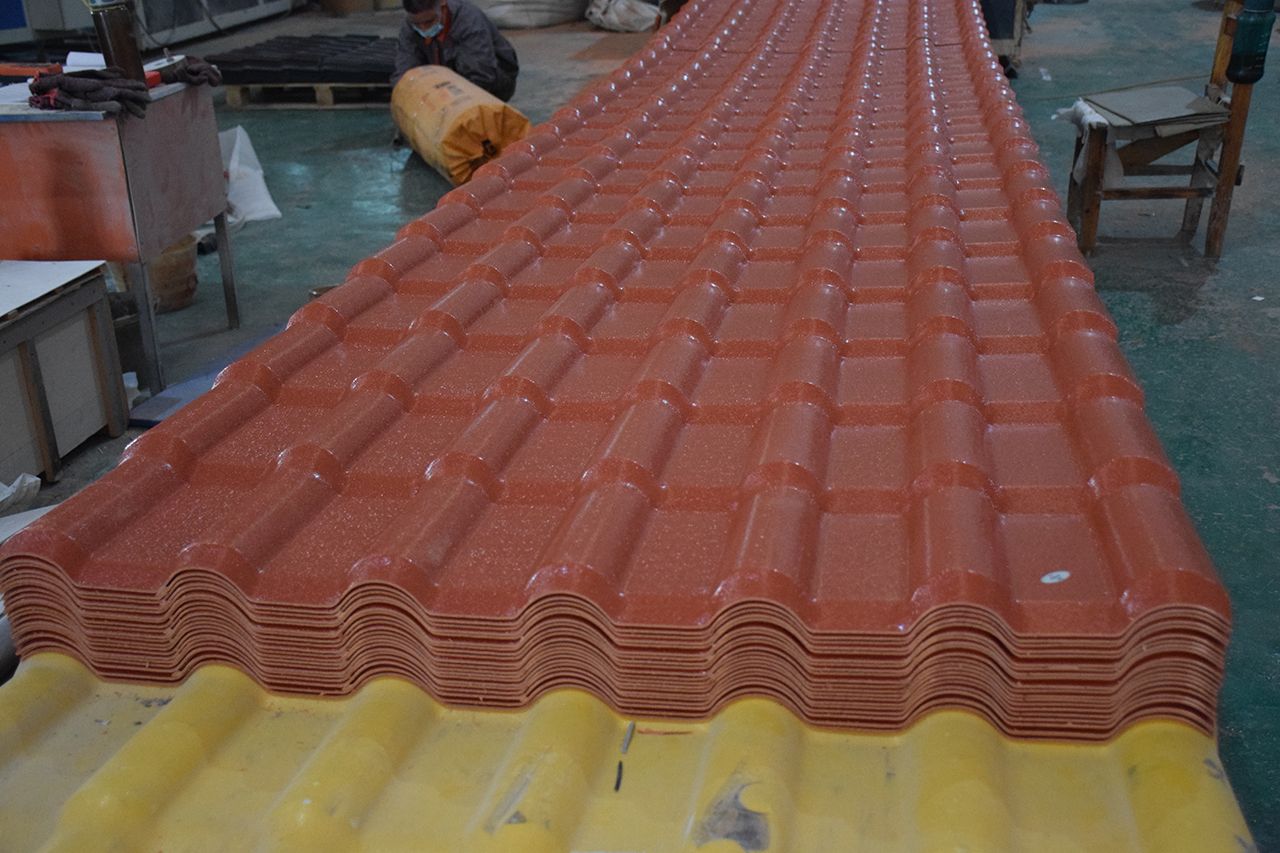
In terms of width, the effective width of resin roofing tiles under national standards is typically 1,050 mm. This is designed to facilitate overlapping, thereby reducing waste during installation. Some non-standard products are labeled as 1,100 mm, but their actual effective width may be only slightly more than 1,000 mm; be sure to ask for clarification before purchasing.
The length can be customized based on the roof’s conditions. Typically, the standard factory lengths range from 6 to 8 meters. The longer the roof, the fewer joints there will be, and the better the waterproofing performance will be. If the span is exceptionally large, a joint must be made in the middle. Since joints are the areas most prone to leaks, it is essential to ensure they are thoroughly sealed.
Whether you choose the longer or shorter option depends on the spacing of your roof trusses. Generally, when the spacing between purlins ranges from 0.75 meters to 1 meter, the load-bearing capacity of the resin roofing tiles is sufficient to meet the requirements. Once the spacing exceeds 1 meter, it is recommended to add reinforcing components; otherwise, you may hear creaking sounds inside the house when walking around during rainy weather.
Corrugated Designs and Applications
There are several types of corrugated resin roofing tiles, the most common of which are the AB type, the ST type, and the wave type. The AB type has relatively shallow corrugations, making it suitable for roofs with a gentler slope. The ST type has deeper corrugations, which allow for faster drainage, making it suitable for rainy regions in southern China.
What many homeowners don’t realize is that resin roofing tiles can actually be combined with other materials. For example, you can use transparent skylight tiles on the roof of a sunroom and dark-colored resin roofing tiles around the edges. This approach not only allows natural light to enter but also provides privacy. This approach is becoming increasingly popular in self-built homes.
While the specifications and models may seem complicated at first glance, once you focus on the three key parameters—thickness, width, and length—you can generally determine the quality of a product. Don’t be misled by flashy marketing claims; data obtained from actual measurements is far more reliable than what you see in advertisements.
Keywords: Synthetic Resin Roof Tile Specifications and Models